CR350
CR350
OrderableConfigurableMeasurement and Control Datalogger
Lower powered than the CR300.
Pricing
Configuration
Sign in for option pricing- No Additional ComsCR350-NA
- w/900MHZ RadioCR350-RF407
- w/1W 900MHz Radio for use in US/CanadaCR350-RF452-NA
- w/Wireless ModemCR350-WIFI
- w/4G LTE CAT1 ATT Provisioned for AT&T North AmericaCR350-CELL205-AT
- w/4G LTE CAT1 VZW Provisioned for Verizon USCR350-CELL210-V
- 4G LTE CAT1 VZW Provisioned for Verizon US Static IPCR350-CELL210-VS
- w/CELL215 w/CAT1 for EMEA No ProvisioningCR350-CELL215-NP
- w/4G LTE CAT1 Telstra for Australia/NZ No ProvisioningCR350-CELL220-NP
- w/4G CAT M1 NB-IoT No ProvisioningCR350-CELL230-NP
Select a configuration to add to your quote
- Model:
- CR350
- Item Number:
- CR350
- Warranty:
- 3 years
- Lead time:
- 21 days
Overview
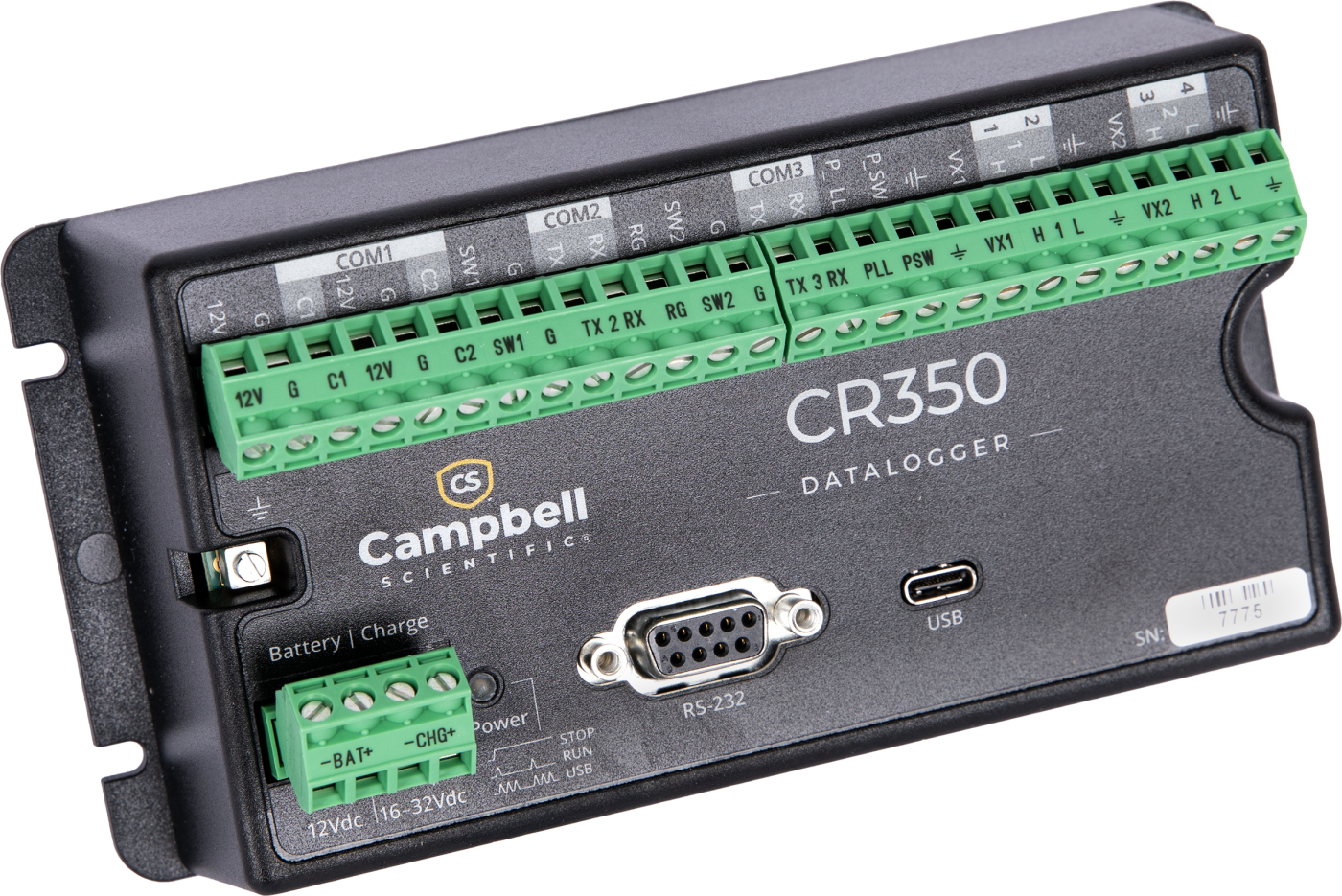
The CR350 is a multi-purpose, extremely low-power, compact measurement and control data logger. This entry-level data logger, with its rich instruction set, can measure most hydrological, meteorological, environmental, and industrial sensors. The CR350 concentrates and makes data available over varied networks, with delivery using your preferred protocol. The CR350 also performs automated on-site or remote decision-making for control and M2M communications. This data logger is ideal for small applications requiring long-term, remote monitoring and control.
The following outlines the primary differences between the CR310 and CR350 dataloggers:
- The CR310 and CR350 offer removable connectors.
- The CR310 includes a 10/100 Ethernet connection.
- The CR350 has two independent RS-232/RS-485 ports and USB-C.
The CR350 includes Wi-Fi, cellular, or the following radio options for different regions:
- CR350-RF407: US and Canada
- CR350-RF412: Australia and New Zealand
- CR350-RF422: UK and EU
- CR350-RF427: Brazil
Note: Campbell Scientific does not recommend the CR350 for use as a PakBus router in networks with more than 50 devices. Large arrays or string variables may also reach memory limits. For such applications, a CR1000Xe Measurement and Control Datalogger is recommended.
Key Advantages
Ideal for small applications
Technical Description
The CR350 is a low-powered data logger designed to measure sensors, analyze data, and store data and programs. A battery-backed clock assures accurate timekeeping. The on-board, BASIC-like programming language—common to all Campbell Scientific data loggers—supports data processing and analysis routines.
Terminal Descriptions
- Two switched 12 V terminals (SW12V) for powering sensors or communications devices, 2100 mA
- Two sensor excitation or continuous 0.15 to 5 V terminals (VX1, VX2) for sensor excitation or output control
- Four multipurpose analog input terminals (SE1–SE4)
- Analog functions (SE1–SE4)
- Analog inputs: 4 single-ended or 2 differential inputs with -100 to +2500 mV and ±34 mV ranges 24 bit ADC
- 4 to 20 mA or 0 to 20 mA inputs (SE1, SE2 only)
- Digital I/O functions (SE1–SE4) consist of 3.3 V logic levels for:
- High frequency counter (35 kHz)
- Pulse width modulation
- Interrupts and timer input
- Period average (200 kHz, amplitude dependent)
- Analog functions (SE1–SE4)
- Two pulse counting terminals (P_SW, P_LL)
- P_SW
- Switch closure (150 Hz)
- High frequency counter (35 kHz)
- P_LL
- Low level ac (20 kHz)
- High frequency counter (20 kHz)
- P_SW
- Two control terminals (C1, C2): C terminals are software configurable for digital functions.
- Digital I/O functions consist of 5 V output and 3.3 V input logic levels for:
- SDI-12
- High frequency counter (3 kHz)
- Switch closure (150 Hz)
- General status/control voltage source 5 V; 10 mA @ 3.5 V
- Interrupts
- Serial asynchronous communications Tx/Rx pair
- Digital I/O functions consist of 5 V output and 3.3 V input logic levels for:
Benefits
- Two dedicated SDI-12 terminals to expand SDI-12 sensor use
- Extremely low current requirements
- Two dedicated RS-232/RS-485 terminals to support smart sensors or modems
- Easy setup with PC software and USB-C connectivity
- Ability to measure analog and digital sensors with confidence
- Trusted Campbell Scientific quality, including integral surge and ESD protection
- Integrated radio option to network wirelessly to another node or internet gateway
- CR350-WIFI ideal for short-range, wireless IP communications
- Removable terminal block for easy wiring
- Ability to communicate anywhere using built-in cellular or satellite peripherals
- Integrated 12 V battery solar charge regulator to charge batteries
- Flexibility to connect with PakBus, Modbus, DNP3, GOES, and other standard communications protocols
- Multiple general-purpose I/O and programmability to analyze and control measurement acquisition
- Event-driven communications and physical outputs for notifications
Specifications
- Operating Temperature Range
- -40° to +70°C
- Operating Temperature Range
- Non-condensing environment
- Maximum Scan Rate
- 10 Hz
- Case Material
- High-impact-resistant polycarbonate, recycle code 7
- Analog Inputs
- 4 single-ended or 2 differential
(individually configured)
- Pulse Counters
- 8
(P_SW, P_LL, C1, C2, and SE1 to SE4)
- Voltage Excitation Terminals
- 2
(VX1, VX2)
- Communications Ports
- USB Type C 2.0
- Communications Ports
- RS-232
- Communications Ports
- RS-485
- Switched 12 Volt
- 2 terminals
- Digital I/O
- 7 terminals (C1, C2, P_SW, and SE1 to SE4) configurable for digital input and output
Includes status high/low, pulse width modulation, external interrupt, and communications functions. Exception: C2 and P_SW don’t do pulse-width modulation.
- Analog Input Limits
- -100 to +2500 mV
- Analog Voltage Accuracy
- Accuracy specifications do not include sensor or measurement noise.
- Analog Voltage Accuracy
- ±(0.04% of measurement + offset) at 0° to 40°C
- Analog Voltage Accuracy
- ±(0.1% of measurement + offset) at -40° to +70°C
- ADC
- 24-bit
- Charge Terminal Characteristics (CHG+ and CHG-)
- Input from power converter or solar panel, typical
- Charge Terminal Characteristics (CHG+ and CHG-)
- ES1 PS2 energy sources only
(Energy Source Class 1 [ES1] and Power Source Class 2 [PS2], as defined in Clauses 5 and 7 of IEC/AS/NZS 62368-1:2022)
- Charge Terminal Characteristics (CHG+ and CHG-)
- 16 to 32 Vdc
- Charge Terminal Characteristics (CHG+ and CHG-)
- Hold current limit 1.1 A @ 20°C
- Battery Terminal Characteristics (BAT+ and BAT-)
- Input from external battery, 7 Ah lead-acid, typical
- Battery Terminal Characteristics (BAT+ and BAT-)
- Voltage input 12 Vdc only
- Battery Terminal Characteristics (BAT+ and BAT-)
- Hold current limit 3.7 A @ 20°C
- Internal Lithium Battery
- 3 V coin cell CR2032X for battery-backed clock
- Internal Lithium Battery
- 6-year life with no external power source
- Real-Time Clock Accuracy
- ±3 min. per year
- Internet Protocols
- Ethernet, PPP, RNDIS, ICMP/Ping, Auto-IP(APIPA), IPv4, IPv6, UDP, TCP, TLS (v1.2), DNS, DHCP, SLAAC, NTP, Telnet, HTTP(S), FTP(S), SMTP/TLS, POP3/TLS, MQTT(S)
- Communications Protocols
- PakBus, PakBus Encryption, Modbus RTU/ASCII/TCP, DNP3, SDI-12, and others
- CPU Drive/Programs
- 50 MB serial flash
- Data Storage
- 50 MB serial flash
- Idle Current Drain, Average
- 0.5 mA
(@ 12 Vdc)
- Active Current Drain, Average
- < 1.5 mA
(@ 12 Vdc for 1 Hz scan with 1 analog measurement)
- Active Current Drain, Average
- 8 mA
(@ 12 Vdc with processor always on)
- Dimensions
- 16.3 x 8.4 x 5.6 cm
(6.4 x 3.3 x 2.2 in.)
Additional clearance required for cables and leads - Weight
- 288 to 306 g
(0.64 to 0.68 lb) depending on communications option selected
CR350-RF407 Option
- Radio Type
- Frequency Hopping Spread Spectrum
(FHSS)
- Output Power
- 5 to 250 mW
(user-selectable)
- Frequency
- 902 to 928 MHz
(US, Canada)
- RF Data Rate
- 200 kbps
- Receive Sensitivity
- -101 dBm
- Antenna Connector
- RPSMA
(External antenna required; see www.campbellsci.com/order/rf407 for Campbell Scientific antennas)
- Idle Current Drain, Average
- 12 mA
(@ 12 Vdc)
- Active Current Drain, Average
- < 80 mA
(@ 12 Vdc)
CR350-RF412 Option
- Radio Type
- Frequency Hopping Spread Spectrum
(FHSS)
- Output Power
- 5 to 250 mW
(user-selectable)
- Frequency
- 915 to 928 MHz
(Australia, New Zealand)
- RF Data Rate
- 200 kbps
- Receive Sensitivity
- -101 dBm
- Antenna Connector
- RPSMA
(External antenna required; see www.campbellsci.com/order/rf412 for Campbell Scientific antennas)
- Idle Current Drain, Average
- 12 mA
(@ 12 Vdc)
- Active Current Drain, Average
- < 80 mA
(@ 12 Vdc)
CR350-RF422 Option
- Radio Type
- 868 MHz SRD 860 with Listen Before Talk (LBT) and Automatic Frequency Agility (AFA)
- Output Power
- 2 to 25 mW
(user-selectable)
- Frequency
- 863 to 870 MHz
(European Union)
- RF Data Rate
- 10 kbps
- Receive Sensitivity
- -106 dBm
- Antenna Connector
- RPSMA
(External antenna required; see www.campbellsci.com/order/rf422 for Campbell Scientific antennas)
- Idle Current Drain, Average
- 9.5 mA
- Active Current Drain, Average
- 20 mA
CR350-RF427 Option
- Radio Type
- Frequency Hopping Spread Spectrum
(FHSS)
- Output Power
- 5 to 250 mW
(user-selectable)
- Frequency
- 902 to 907.5 MHz/915 to 928 MHz
(Brazil)
- RF Data Rate
- 200 kbps
- Receive Sensitivity
- –101 dBm
- Antenna Connector
- RPSMA
(External antenna required)
- Idle Current Drain, Average
- 12 mA
(@ 12 Vdc)
- Active Current Drain, Average
- < 80 mA
(@ 12 Vdc)
CR350-RF452 Option
- Radio Type
- Frequency Hopping Spread Spectrum
(FHSS)
- Output Power
- 10 mW to 1,000 mW
(user-selectable)
- Frequency
- 902 to 928 MHz
- RF Data Rate
- 115.2 or 153.6 kbps
- Receive Sensitivity
- -108 dBm
(@ 115.2 kbps for 10-4 BER)
- Receive Sensitivity
- -103 dBm
(@ 153.6 kbps for 10-4 BER)
- Antenna Connector
- RPSMA
(External antenna required)
- Idle Current Drain, Average
- < 29 mA
(maximum @ 12 Vdc)
- Active Current Drain, Average
- < 84 mA
(maximum @ 12 Vdc)
CR350-WIFI Option
- Operational Modes
- Client or Access Point
- Operating Frequency
- 2.4 GHz, 20 MHz bandwidth
- Antenna Connector
- Reverse Polarity SMA
(RPSMA)
- Antenna
- pn 16005 unity gain (0 dBd), 1/2 wave whip, omnidirectional with articulating knuckle joint for vertical or horizontal orientation
- Transmit Power
- 7 to 18 dBm
(5 to 63 mW)
CR350-CELL205 Option
- -NOTE-
- The CR350-CELL205 option is not compatible with a Verizon cellular network.
- Certifications
- IC (Industry Canada)
10224A-201611EC21A
- Cell Technologies
- 3G
(UMTS/HSPA+)
- Cell Technologies
- 4G
(LTE CAT-1)
- 3G Frequency Bands
- 850, 1700/2100 (AWS), and 1900
- 4G Frequency Bands
- 700, 850, 1700/2100 (AWS-1), 1900
- Antenna Connector
- SMA
(External antenna required; see www.campbellsci.com/order/cr350 for Campbell Scientific antennas)
- Power Consumption - Idle
- 14 mA
(average)
- Power Consumption - Active
- 75 mA
(average)
- SIM Interface
- 3FF (6 position/contacts)
Supports SIMs that require 1.8 or 3 V - Radio Output Power
- 23 dBm on LTE
- Radio Output Power
- 24 dBm on UMTS
- Radio Output Power
- 27 dBm on EDGE
- Radio Output Power
- 33 dBm on GSM
- Radio Sensitivity Range
- -99.5 to 110.5 dBm
(10 M)
CR350-CELL210 Option
- -NOTE-
- The CR350-CELL210 option is only compatible with a Verizon cellular network.
- Cell Technologies
- 4G
(LTE CAT-1)
- 4G Frequency Bands
- 700, 850, 1700, 1900, 2100
- Antenna Connector
- SMA
(External antenna required; see www.campbellsci.com/order/cr350 for Campbell Scientific antennas)
- Power Consumption - Low Power Mode
- 5 mA
- Power Consumption - Idle
- 28 mA
(average)
- Power Consumption - Active
- 90 mA
(average)
- SIM Interface
- 3FF (6 position/contacts)
Supports SIMs that require 1.8 or 3 V - Radio Output Power
- 23 dBm on LTE
- Radio Sensitivity Range
- -99.5 to 110.5 dBm
(10 M)
CR350-CELL215 Option
- -NOTE-
- The CR350-CELL215 option is intended for use in EMEA countries.
- Cell Technologies
- 2G
(GSM/GPRS/EDGE)
- Cell Technologies
- 3G
(UMTS/HSPA+)
- Cell Technologies
- 4G
(LTE CAT-1)
- 2G Frequency Bands
- 900 and 1800 MHz
- 3G Frequency Bands
- 850, 900, and 2100 MHz
- 4G Frequency Bands
- 800, 850, 900, 1800, 2100, and 2600 MHz
- Antenna Connector
- SMA
(External antenna required; see www.campbellsci.com/order/cr350 for Campbell Scientific antennas)
- Power Consumption - Idle
- 14 mA
(average)
- Power Consumption - Active
- 75 mA
(average)
- SIM Interface
- 3FF (6 position/contacts)
Supports SIMs that require 1.8 or 3 V - Radio Output Power
- 23 dBm on LTE
- Radio Output Power
- 24 dBm on UMTS
- Radio Output Power
- 27 dBm on EDGE
- Radio Output Power
- 33 dBm on GSM
- Radio Sensitivity Range
- -99.5 to 110.5 dBm
(10 M)
CR350-CELL220 Option
- -NOTE-
- The CR350-CELL220 option is intended for use in Australia and New Zealand.
- Cell Technologies
- 3G
(UMTS/HSPA+)
- Cell Technologies
- 4G
(LTE CAT-1)
- 3G Frequency Bands
- 850 and 2100 MHz
(EC-21AUT)
- 3G Frequency Bands
- 850, 900, 1900, and 2100 MHz
(EC-21AU)
- 4G Frequency Bands
- 700, 850, 1800, 2100, and 2600 MHz
(EC-21AUT)
- 4G Frequency Bands
- 700, 900, 1700, 1800, 1900, 2100, and 2600 MHz
(EC-21AU)
- Antenna Connector
- SMA
(External antenna required; see www.campbellsci.com/order/cr350 for Campbell Scientific antennas)
- Power Consumption - Idle
- 14 mA
(average)
- Power Consumption - Active
- 75 mA
(average)
- SIM Interface
- 3FF (6 position/contacts)
Supports SIMs that require 1.8 or 3 V - Radio Output Power
- 23 dBm on LTE
- Radio Output Power
- 24 dBm on UMTS
- Radio Sensitivity Range
- -99.5 to 110.5 dBm
(10 M)
CR350-CELL225 Option
- -NOTE-
- The CR350-CELL225 option is intended for use in Japan.
- Cell Technologies
- 4G
(LTE CAT-1)
- 4G Frequency Bands
- 800 (lower), 800 (upper), 850+, 900, 1800, and 2100 MHz
- Antenna Connector
- SMA
(External antenna required; see www.campbellsci.com/order/cr350 for Campbell Scientific antennas)
- Power Consumption - Idle
- 14 mA
(average)
- Power Consumption - Active
- 75 mA
(average)
- SIM Interface
- 3FF (6 position/contacts)
Supports SIMs that require 1.8 or 3 V - Radio Output Power
- 23 dBm on LTE
- Radio Sensitivity Range
- -99.5 to 110.5 dBm
(10 M)
CR350-CELL230 Option
- Cell Technologies
- LTE-Cat M, NB-IoT
- Frequency Bands
- LTE M B1/B2/B3/B4/B5/B8/
B12/B13/B18/B19/B20/
B25/B26/B27/B28/B66/B85 - Frequency Bands
- LTE NB-IoT B1/B2/B3/B4/B5/B8/
B12/B13/B18/B19/B20/
B25/B28/B66/B71/B85 - Antenna Connector
- SMA
(External antenna required; see www.campbellsci.com/order/cr350 for Campbell Scientific antennas)
- Power Consumption - Idle
- 23 mA average
(26 mA if GPS is on)
- Power Consumption - Active
- 50 mA average
(53 mA if GPS is on)
- SIM Interface
- 3FF (6 position/contacts)
Supports SIMs that require 1.8 or 3 V
Accessories
(22)CELLDATA
Campbell Scientific Cellular Data Service Subscription
Orderable39580
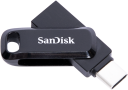
32 GB USB Flash Drive
Orderable18663
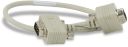
Null Modem Cable, 9-Pin PIn (Male) to 9-Pin Pin (Male)
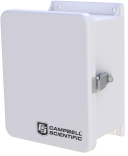
OrderableENC8/10
Weather-Resistant Enclosure, 8 x 10 inches
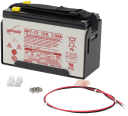
OrderableBP7
7 Ah 12 V Sealed Rechargeable Battery
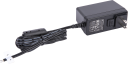
Orderable39177
1.67 A 24 Vdc Power Supply
Orderable16755
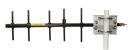
2.4 GHz 13 dBd Yagi Enclosed Antenna with Mounting Hardware
Orderable30411
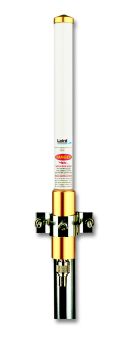
2.4 GHz 5.8 dBd Omnidirectional Fiberglass Antenna without Mounting Hardware
Orderable15730
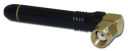
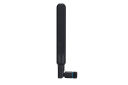
900 MHz 0 dBd 1/4 Wave Omnidirectional Antenna with RPSMA Connector
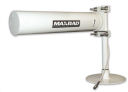
Orderable14201
900 MHz 9 dBd Yagi Antenna with Mounting Hardware
Orderable14221
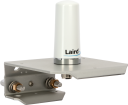
900 MHz 3 dBd Omnidirectional Antenna with Mounting Hardware
Orderable38485
4G/3G 9 dBi MIMO Cellular Antenna with 2 Type N Socket (Female) Connectors
Orderable32256
4G/3G Cellular Whip Antenna with SMA Connector
Orderable32262
2 dBd 4G/3G Multiband Omnidirectional Antenna with Mounting Hardware
Orderable31182
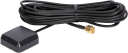
27 dBi GPS Antenna with 3 V Magnetic Mount and SMA Connector
Orderable21847
Cellular Phone Antenna Cable, Type N Pin (Male) to SMA
OrderableCOAXRPSMA
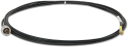
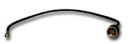
LMR195 Antenna Cable with Reverse Polarity SMA and Type N Pin (Male) Connector
OrderableCOAXNTN
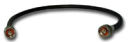
RG8 Antenna Cable with 2 Type N Pin (Male) Connectors
OrderableCOAXSMA
LMR195 Antenna Cable with SMA and Type N Pin (Male) Connector
Orderable31314
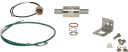
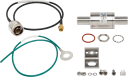
Surge Protection Kit, Type N to RPSMA, 700 to 2700 MHz
Orderable31317
Surge Protection Kit, Type N to SMA, 700 to 2700 MHz
Orderable21212
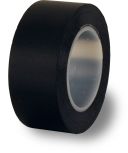
Black Cold Shrink Tape
Orderable
Related Resources
Case Studies
Documents
Videos and Tutorials

Documenting Data Logger Wiring Using an Excel Template
March 22, 2024 (5:41)
Using an Excel template to create a wiring diagram for a data logger
Watch
Fundamentals of CRBasic Programming Part 1: Variables
April 28, 2023 (13:21)
Demonstrates how to declare variables, types of variables available, and when to use them.
Watch
Fundamentals of CRBasic Programming Part 2: Tables
July 20, 2022 (8:47)
Discusses how to configure data tables to store final data.
Watch
CRBasic Functions
January 24, 2024 (6:23)
CRBasic Functions
Watch- View all videos and tutorials