TX326
TX326
OrderableConfigurableSatellite Transmitter for Meteosat
Pricing
- Model:
- TX326
- Item Number:
- 42799
- Warranty:
- 1 year
- Lead time:
- 21 days
Overview
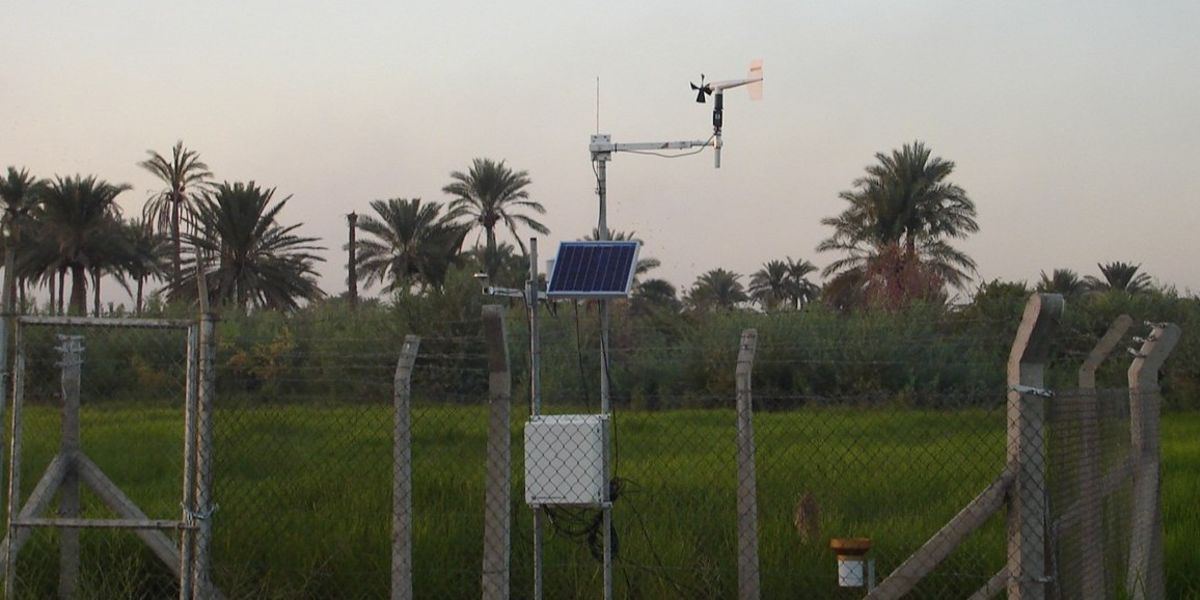
The TX326 is a satellite transmitter that uses the Meteosat satellite system to provide one-way communications from a data collection platform (DCP) to a receiving station.
Meteosat is a system of geostationary meteorological satellites operated by EUMETSAT (European Organisation for the Exploitation of Meteorological Satellites). Geostationary satellites have orbits that coincide with the Earth's rotation, allowing each satellite to remain above a specific region. EUMETSAT is an intergovernmental organization created through an international convention of European countries.
Key Advantages
Technical Description
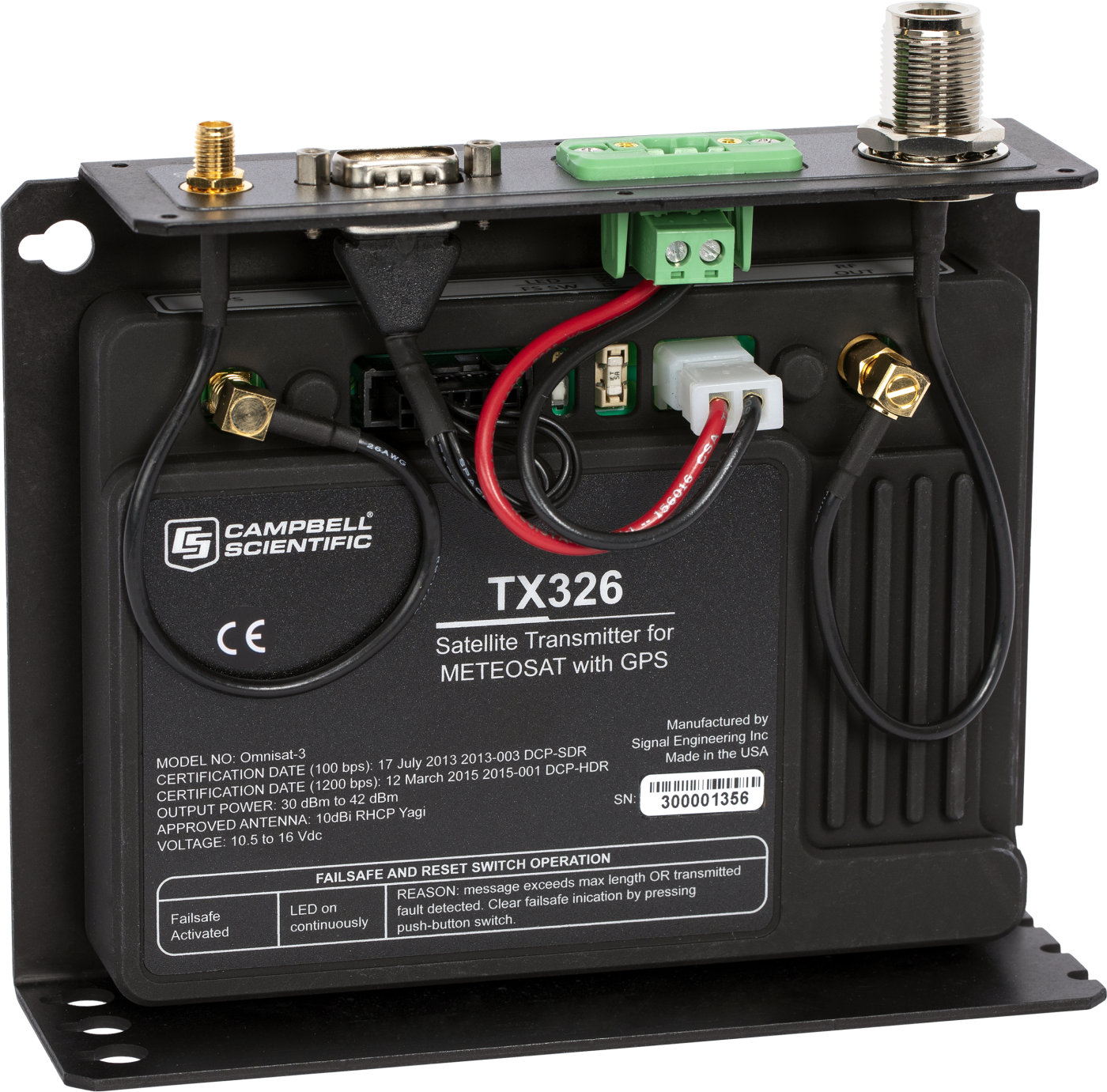
The TX326 transmitter uses the Meteosat satellite system to provide one-way communications from a data collection platform (DCP) to a receiving station. Supported transmission rates are 100 (SRDCP) and 1200 (HRDCP) bps. This transmitter is used with our CR300, CR310, CR1000X, and CR6 dataloggers, as well as with our GRANITE measurement and control data-acquisition systems.
Because clock accuracy is critically important for Meteosat satellite telemetry, the TX326 includes an embedded GPS receiver. The GPS receiver automatically corrects for clock and oscillator drift, allowing for longer intervals between service visits.
Detailed diagnostic information about the radio is also available for the field technician and various diagnostic uses. These diagnostic parameters include the following:
- Latitude and longitude using the built-in GPS
- Current battery voltage
- Current temperature
- Battery voltage before last transmission
- Temperature before last transmission
- Battery voltage during last transmission
- Altitude of last GPS position
- Time of last GPS position
- Number of GPS fix misses
- Time of last missed GPS fix
- GPS receiver health and status
- Failsafe tripped indication
- Duration of last transmission
- Forward power of last transmission
- Reflect power on last transmission
- VSWR (voltage standing wave ratio) last transmission results
- Current transmission state
Cable Options
On the Ordering Information page of the website, ensure you order the correct cable option to meet your needs.
- To connect the TX326 to the CR6 or CR1000X RS-232/CPI port. select the -R option.
- To connect the TX326 to the COM (C, U) ports of a data logger, select the -C option.
- To connect the TX326 to the 9-pin RS-232 port of a data logger, select the -S option.
Benefits
- EUROSAT SRDCP and HRDCP certified
- Compatible with Meteosat satellite data collection system
- Easy integration with Campbell Scientific data loggers
- Field tested and proven track record of reliability
- Embedded GPS receiver for stabilized internal time keeping and transmit frequency for long service intervals
- Low standby current consumption for battery-powered systems at remote DCP installation sites
- Quick assessment of radio health via monitoring of diagnostic data from the radio
Specifications
- Transmissions Supported
- Self-Timed
(Scheduled)
- Transmissions Supported
- Alarm
(Random)
- Data Format
- ASCII data with restrictions
- Data Format
- ASCII data
- Data Format
- Binary data
- Data Format
- Pseudo binary
(1200 baud only)
- Data Format
- Meteosat alert message
- Transmit RF Out Connector
- Type N jack
- Radio Module
- OmniSAT-3
- Operating Temperature Range
- -40° to +60°C
- Storage Temperature Range
- -55° to +75°C
- EUMETSAT DCP Radio Certification (2013-003)
- EUMETSAT DCP Radio Certification (2013-003)
- EUMETSAT 2013-003-DCP-SDR (17 July 2013)
for standard rate (100 bps)
- EUMETSAT DCP Radio Certification (2013-003)
- EUMETSAT 2015-001-DCP-HDR (12 March 2015)
for high rate (1200 bps)
- Time-of-Day Clock
- Accurate to 20 ms with GPS receiver.
- Case Dimensions
- 15.88 x 12.7 x 4.57 cm
(6.25 x 5 x 1.8 in.) not including connectors
- Maximum Dimensions
- 15.88 x 14.99 x 4.57 cm
(6.25 x 5.9 x 1.8 in.) including connectors
- Weight
- 0.77 kg
(1.7 lb)
Supply Power
- Supply Voltage Range
- 10.5 to 16 Vdc
- Typical Current Drain
- < 2.75 A when transmitting
(typical 1.8 A at 12 Vdc) to 4 A maximum
- Typical Current Drain
- < 5 mA standby
(typical 2.8 mA at 12 Vdc)
- Typical Current Drain
- < 40 mA during GPS acquisition
(typical 25 mA at 12 Vdc)
- Connector
- 2-pin screw terminal, 0.2 in. pitch
- Power Protection
- Up to 23.1 V (reverse polarity and overvoltage)
Total system current is fused at 5 A with replaceable fuse
Satellite Communication
- Baud Rates
- 100 (tolerance ±0.005 bps) and 1200 bps (tolerance ±0.06 bps)
- Transmit Power (100 baud)
- 42 dBm maximum
- Transmit Power (100 baud)
- Maximum EIRP is 52 dBm
(based on 11 dbm gain antenna and 1 dbm line loss)
- Transmit Power (100 baud)
- Typical EIRP is 47 to 52 dBm.
- Transmit Power (1200 baud)
- 50 dBm maximum
- Transmit Power (1200 baud)
- Maximum EIRP is 50 dBm
(based on a 11 dbm gain antenna with 1 dbm line loss)
- Transmit Power (1200 baud)
- Typical EIRP is 40 to 50 dBm.
- Frequency Range - Meteosat
- 402.0355 MHz (channel #1) to 402.4345 MHz (channel #267)
(267 channels with a 1.5 KHz channel bandwidth each.)
- Frequency Range - International
- 402.0025 MHz (channel #268) to 402.034 MHz (channel #289)
(21 channels reassigned from international bandwidth 1.5 KHz.)
- Initial Frequency Stability
- < ±20 Hz disciplined to GPS
(GPS fix occurs after power up and once per day thereafter.)
- Initial Frequency Stability
- Maximum ±125 Hz without GPS
- Channel Bandwidth
- 100/1200 Baud 1.5 KHz
GPS Receiver
- -NOTE-
- The TX326 can source up to 19 mA at 2.7 V for an external GPS antenna. Campbell Scientific recommends a maximum antenna Low-Noise Amplifier (LNA) of 1.5 dB.
- Maximum RF Input Gain
- 25 dB
- Receiver Type
- 3.3 V active
- Connector Type
- SMA jack
Timekeeping
- Initial Accuracy
- ±100 μs
(synchronized to GPS)
- Drift
- ±40 ms/day
(without GPS)
- GPS Schedule
- 1 fix at power up
(updated at roughly an 11-hour rate)
- Transmission Continuation without GPS Fix
- 6 days
Interface Connectors
- RS-232
- DB9 M, DTE, 3-wire RS-232