OBS300
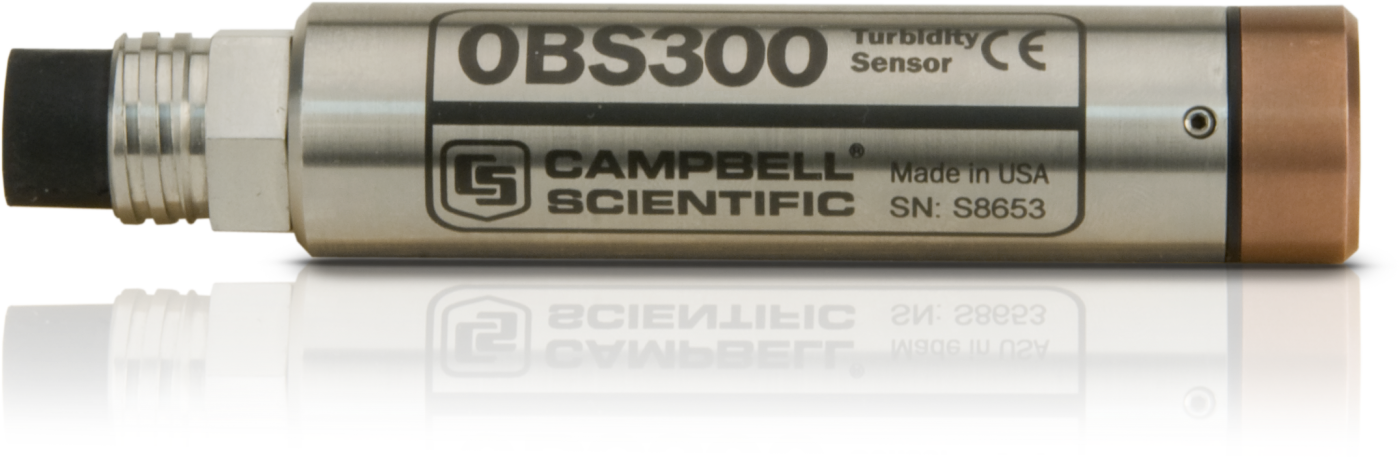
OBS300
RetiredConfigurableTurbidity Sensor
Compact, low-power, downward-looking turbidity sensor.
Pricing
- Model:
- OBS300
- Item Number:
- 26475
- Warranty:
- 1 year
- Lead time:
- 14 days
Overview
The OBS300 is a submersible turbidity probe that has downward-facing optics. It uses OBS technology to measure suspended solids and turbidity for applications ranging from water quality in freshwater rivers and streams to sediment transport and dredge monitoring. Campbell Scientific data loggers measure the OBS300 probe's output and calculate turbidity.
Key Advantages
Optics avoid obstructions on sides of probe
Technical Description
The OBS300 uses its downward-facing optics to emit a near-infrared light into the water. It then measures the light that bounces back from the water’s suspended particles.
If an obstruction is in the emitted light’s range, the light will scatter back and the turbidity reading will be too high. This probe's downward-facing optics avoid obstructions around the sides of the probe. The OBS-3+ is available for locations that have obstructions above and below the probe. (OBS® is a registered trademark of Campbell Scientific.)
Benefits
- Downward-facing optics avoid obstructions around the sides of the probe
- Measures suspended solids and turbidity for up to 4000 NTUs
- Provides a compact, low-power probe that is field proven
- Stainless-steel body allows use down to 500 m in fresh water
- Compatible with most Campbell Scientific data loggers
- Titanium body allows use down to 1500 m in fresh or salt water
- Accurate and rugged
- Fitted with MCBH-5-FS, wet-pluggable connector—multiple mating cable length options available
- Offers an optional five-point sedimentation calibration for better measurements (see Ordering Info on the web page)
Specifications
- Range
- 0 to 250 NTU
- Range
- 0 to 500 NTU
- Range
- 0 to 1000 NTU
- Range
- 0 to 3000 NTU
- Range
- 0 to 4000 NTU
- Maximum Submersion Depth
- 500 m
(1640.5 ft) for stainless-steel body
- Maximum Submersion Depth
- 1500 m
(4921.5 ft ) for titanium body
- Maximum Concentration Range
- Maximum concentration depends on sediment size, particle shape, and reflectivity.
- Maximum Concentration Range
- 5,000 to 10,000 mg/l
(for mud)
- Maximum Concentration Range
- 50,000 to 100,000 mg/l
(for sand)
- Concentration Accuracy
- 2% of reading or 1 mg/l
(whichever is larger) for mud
- Concentration Accuracy
- 4% of reading or 10 mg/l
(whichever is larger) for sand
- Operating Temperature Range
- 0° to 40°C
- Drift over Time
- < 2% per year
- Maximum Data Rate
- 10 Hz
- Minimum Warm-up Time
- 2 s
- Infrared Wavelength
- 850 nm ±5 nm
- Daylight Rejection
- -28 dB
(re: 48 mW/cm-2)
- Optical Power
- 2000 µW
- Turbidity Accuracy
- 2% of reading or 0.5 NTU
(whichever is larger)
- Housing Material
- 316 stainless steel or titanium
- Connector
- MCBH-5-FS, wet-pluggable
- Diameter
- 2.5 cm
(0.98 in.)
- Height
- 13.1 cm
(5.15 in.)
- Weight
- 181.4 g
(0.4 lb)
-2.5 Output Option
- Output Voltage
- 0 to 2.5 V
(over selected NTU range)
- Supply Voltage
- 5 to 15 Vdc
- Current Drain
- 15 mA
-5 Output Option
- Output Voltage
- 0 to 5 V
(over selected NTU range)
- Supply Voltage
- 5 to 15 Vdc
- Current Drain
- 15 mA
-20 Output Option
- Output Voltage
- 4 to 20 mA
(over selected NTU range)
- Supply Voltage
- 9 to 15 Vdc
- Current Drain
- 45 mA
Accessories
(9)21307
OBS-3+ or OBS300 Cable, 10 m (32.8 ft)
Retired21098
Carrying Case for OBS-3+ or OBS300 (holds 2)
Retired21094
OBS-3+ or OBS300 Cable, 5 m (16 ft)
Retired21308
OBS-3+ or OBS300 Cable, 15 m (49.2 ft)
Retired21309
OBS-3+ or OBS300 Cable, 20 m (65.6 ft)
Retired21311
OBS-3+ or OBS300 Cable, 30 m (98.4 ft)
RetiredOBS-3+CBL-L
OBS-3+ or OBS300 Sensor Cable
RetiredCURS100
100-Ohm Current Terminal Input Module
Orderable20915
OBS Sensor 5-Point Sedimentation Calibration
End of life
Related Resources
Case Studies
Documents
- Technical Paper
OBS: Comparison of Suspended Solids Concentration (SSC) and Turbidity
April 2008
View Document - Technical Paper
OBS Sensors: Light Sources and Photodetectors
April 2008
View Document - Technical Paper
OBS: Effects of Bubbles
April 2008
View Document - Technical Paper
OBS Sensors: Sediment Calibration
April 2008
View Document - View all documents