Everest Project
Episode 4: Testing
Two levels of testing are used to ensure the custom-designed equipment will meet the demanding requirements on Mount Everest: in a lab and on another mountain.
Take a Journey
Journey with us as we build equipment for a truly extreme environment. Watch as we work to design and build Campbell Scientific automated weather stations for installation on Mount Everest. These stations must endure some of the harshest weather conditions in the world to record and transmit continuous, one-of-a-kind real-time weather data.
Reading Vibrating Wire Sensors: Time-Domain Analysis
The traditional method for reading vibrating wire sensors analyzes the response from a sensor as a function of time using period averaging. This technique excites the wire and measures the average time between a predetermined number of positive-slope zero crossings in the wire’s response to give the wire’s resonant period. Figure 4 demonstrates this process. The resonant frequency is the reciprocal of resonant period.
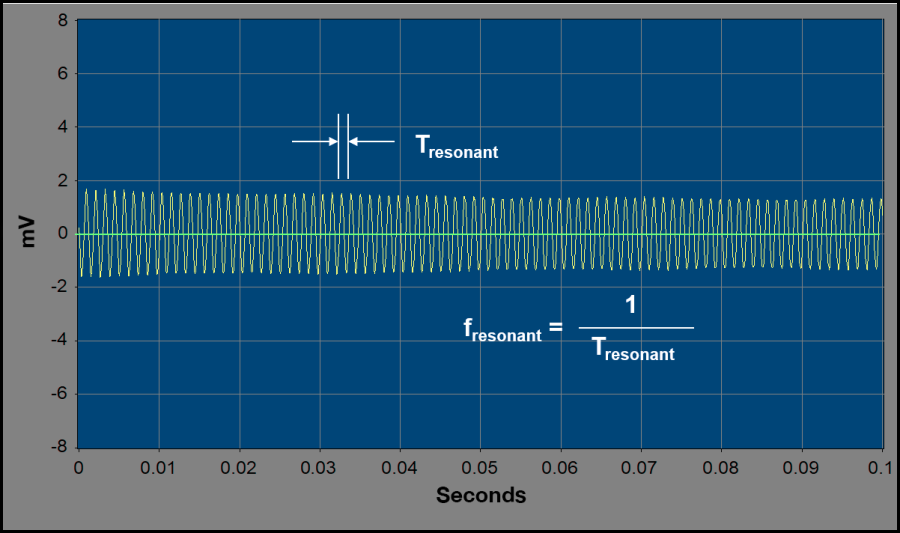
Fig. 4. Vibrating wire time-domain response as a function of time
In a low-noise environment, this is an effective method of determining the resonant frequency of the wire. It has been successfully integrated into many data acquisition products that simplify its application with dedicated hardware modules, programming instructions, and software. This approach struggles, however, in noisy environments, as shown by the erroneous readings in Figure 1.
Figure 5 shows the problem of measuring zero crossings in the presence of external noise.
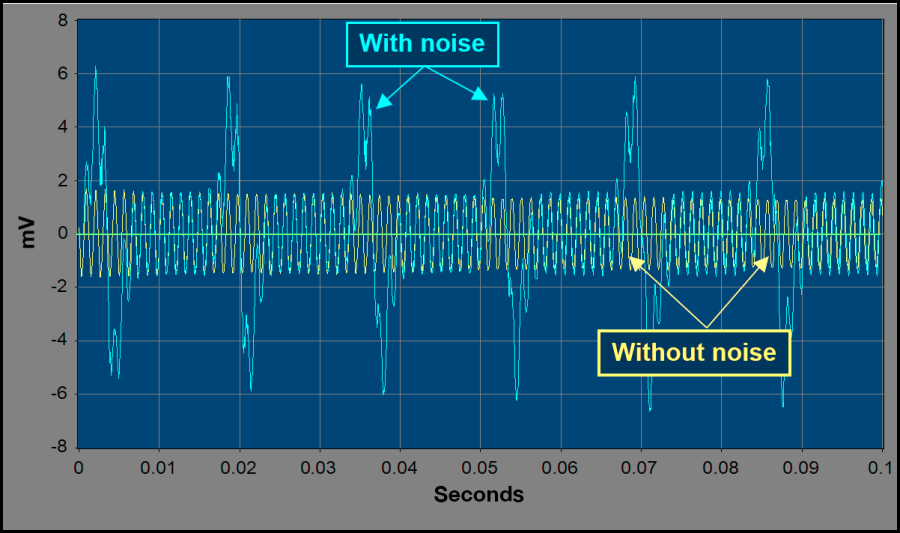
Fig. 5. Vibrating wire time-domain response as a function of time with competing noise
The external noise disrupts the signal, erroneously removing zero crossings. In general, external noise may introduce errors by adding zero crossings to, or by removing zero crossings from, the uncorrupted signal. Even with this difficulty, engineers are sometimes able to gather useful data in noisy environments. However, this requires extra effort to eliminate noise sources or schedule measurements around periods of increased noise. An alternative approach requires data analysts to identify and discard bad data by comparing measurement data before and after noise events.
Given these challenges, instrumentation engineers set out to find a method to determine the resonant frequency of vibrating wire sensors with improved noise immunity.
Episode 2: The Challenge
Several unique challenges had to be addressed in designing a system light enough to be carried up Mount Everest and strong enough to withstand the constant low temperatures and high winds.
Episode 3: Design and Manufacturing
Let’s look at the Extreme Application Series the Campbell Scientific engineers designed and manufactured to be installed on Mount Everest.
Episode 1: Introduction
Campbell Scientific worked to design and manufacture a network of permanent automated weather stations to be installed on Mount Everest. Learn about the planning, design work, and installation of these extreme systems in one of the most rugged environments on Earth.