How much do you know about Campbell Scientific? Do you know how the company, which designs and builds measurement and control products for worldwide use, got its start? This article highlights some little-known facts about the company’s early history that may surprise you. Test your knowledge with these 10 questions, and see how many answers you know.
Test Your Knowledge
#1 - When and where was the company name “Campbell Scientific” chosen?
Brothers Eric, Evan, and Gaylon Campbell chose the company name “Campbell Scientific” in October of 1973, during a road trip they made from Boulder, Colorado, to Logan, Utah.
#2 - What device provided design inspiration for the first Campbell Scientific product?
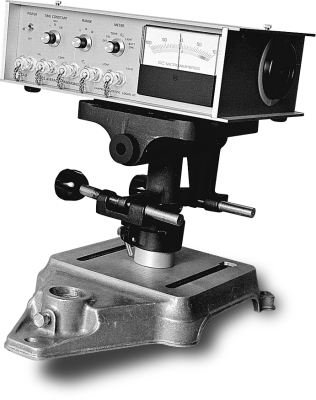
The first Campbell Scientific product, the CA-9 laser anemometer, used half a pair of binoculars in its design. A local jewelry store provided the binoculars, and a band saw was used to cut the binoculars in half. (The CA-9 prototype is shown in the image above.)
#3 - Where were the first Campbell Scientific products made?
The prototype laser anemometer and the first 30 units were built in the basement of the Campbell family home on assembly benches that the Campbell brothers made themselves.
#4 - How did the Campbell brothers have time to make their products and run the business?
Younger Campbell siblings and spouses supplied the needed, economical labor force to help out with tasks such as stuffing circuit boards and paying bills.
#5 - What was the first tool used to trim the circuit boards?
Initially, a pair of sewing scissors was used to trim the circuit boards. After the scissors broke, a paper cutter was used.
#6 - What type of wheel was used to test the laser anemometer?
To test the laser anemometer’s ability to measure wind speed, a bicycle wheel was used. The anemometer calculated the speed at which the spokes of the bicycle wheel interrupted a beam of light that was shone into the anemometer.
#7 - Where was the first field test of the CA-9 conducted?
Using a portable helium-neon laser, the first field test of the CA-9 was conducted on the Campbell family farm in Juniper, Idaho. The laser was set up in the doorway of a shed. It was aligned with the house’s living room window, approximately 150 yards away.
#8 - What practical experience helped the Campbell brothers align the laser?
The Campbell brothers modeled their alignment method after their experience setting fence posts.
#9 - Who was the first Campbell Scientific customer?
The first Campbell Scientific customer was the United States Army, who purchased 10 units of the CA-9.
#10 - In the first Campbell Scientific office, what was the standard office furniture?
The Campbell brothers started building their own desks, but they became busy with filling orders and didn’t finish the desks. To improvise, they created desks by placing the unfinished desk tops on pairs of short filing cabinets.
| Recommended for You: To learn more about how Campbell Scientific has evolved over the past four decades, visit our “Company History” web page. |
How Did You Score?
See what your score means below:
| Score | Campbell Scientific History Knowledge |
| 0 to 2 Correct | No worries. This was supposed to be tough. Try again next time? |
| 3 to 5 Correct | Not bad. You learned a few new things here, didn’t you? |
| 6 to 9 Correct | Pretty impressive. How did you know all this stuff? |
| 10 Correct | Wow. Your knowledge is amazing! Is your last name Campbell? |
If you'd like, you can share how you did in the Comments section below. I’ll confess that, without the answers in front of me, I wouldn’t have known any of these!