Plane of array irradiance (POA) is a well-known term used to quantify the incident irradiance on a given solar array. It is the parameter most directly related to the power output of a PV module and is used extensively in PV performance analysis and modeling of PV arrays. POA irradiance is defined as the sum of the direct normal (DNI) and diffuse (DHI) irradiance components incident on a surface with a given tilt and angle of incidence (AOI), commonly expressed as:
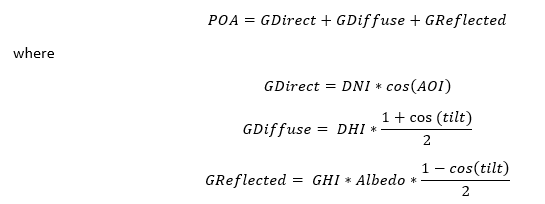
Equation 1. Basic POA Equation. It is worth noting that GReflected is often referred to as RHI, reflected horizontal irradiance, but for illustration purposes relative to bifacial modules in this article, we will use GReflected.
The third component, GReflected, is a function of Albedo, which is defined as the fraction of the irradiance that the surface reflects. Although it is included in the theoretical calculation of POA, the influence of the reflected component has typically been minimized or treated with default values regardless of site conditions. But this approach is no longer sufficient.
The use of bifacial PV modules installed on single axis trackers has intensified greatly over the last couple of years and looks to be an industry mainstay in the years to come. Bifacial modules are built with outward-facing solar cells on both the front and back of the module. This module design enables power to be produced (see Figure 1) from incident solar irradiance on the front of the module (GReflected_front), as well as the reflected irradiance onto the back side of the module (GReflected_back).
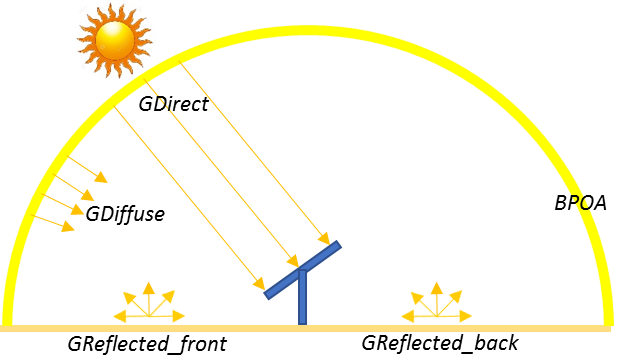
Figure 1. Modelling Irradiance, Including Albedo, on a Bifacial PV Module (Corbellini and Medici, 2015)
With traditional PV, the influence of albedo (reflected irradiance component) could be ignored, but moving forward, it is being included to produce an enhanced plane of array data set, which should support developers’ decisions who could be banking on 5 to 30% increased yields using bifacial PV modules. For lack of industry standard, we will call this enhanced plane of array component a bifacial effective irradiance or bifacial plane of array (BPOA):
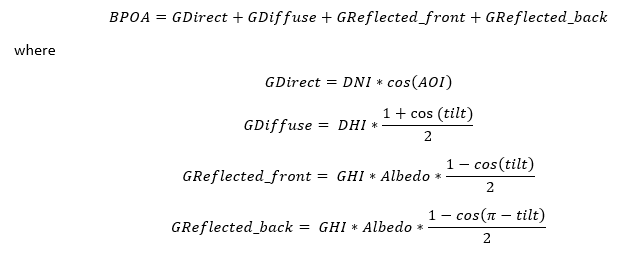
Equation 2. Bifacial POA Equation
Hopefully it is clear that improving the plane of array irradiance data set by including albedo data will increase the quality of bifacial performance simulations. The approach for obtaining the highest accuracy albedo data set, at the lowest cost, is simple: integrate additional sensors to measure albedo as part of a solar resource assessment station or operational MET station.
The good news is that albedo is not a new or expensive measurement. It has long been a common parameter on WMO and BSRN (Baseline Surface Radiation Network) types of networks, and the sensors and hardware to acquire this data are readily available. Figure 2 illustrates a few off-the-shelf components at Campbell Scientific that we use to create an albedo sensor kit. The kit includes the sensors, cabling, and mounting hardware used to retrofit any existing solar MET station for pre-construction resource assessment, bifacial module performance testing, or operational assessment.
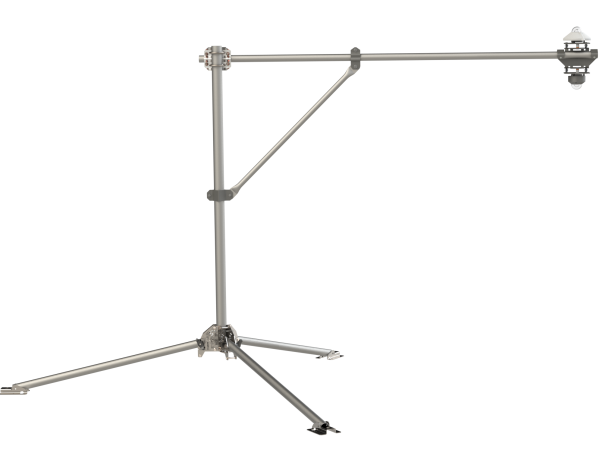
Figure 2. Albedo sensor kit. CM355 quick deploy tripod, CM206 crossarm with brace, CM275 universal sensor albedometer stand.
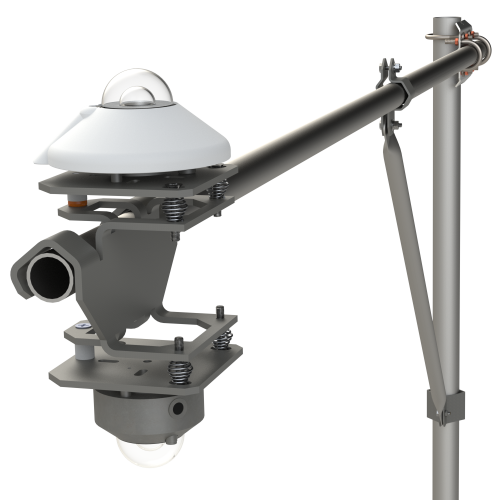
Figure 3. Albedometer mount, CM275 universal sensor albedo stand.
Although the exact design tends to vary depending on the user’s data needs, Table 1 details a more or less complete albedo resource assessment station.
Table 1. Albedo resource assessment station summary
| Item | Description |
| Albedometer | Sensor is installed either (1) fixed horizontally to measure GHI and RHI, which is typical on resource assessment stations or (2) on a single axis tracker to measure GReflected_front and GReflected_back irradiance, which is typical on bifacial module performance testing and operational assessment stations. |
| Reference cell | Sensor is installed on single axis tracker to measure GReflected_back irradiance. |
| Precipitation sensor | Sensor is designed to sense moisture, which could be a result of dew deposition, rainfall, or snow. |
| All-weather sensor | Measures basic weather parameters: air temperature, wind speed, relative humidity, wind direction, barometric pressure, and precipitation. |
| Communications | Cellular and/or Ethernet communications |
| Remote power | Solar panel and battery assure continuous operation in any weather. |
| Mounting and grounding | Tripod or tower with grounding kit |
If you have any questions or wish to discuss, please feel free to contact me at mperry@campbellsci.com.
Related Articles
总日射表介绍
What is a pyranometer? What does it do? How does it work? Learn the answers to these and other questions you may have.
June 14, 2017
蒸散气象站需要定期维护的8个组件
Ensure your ET106 or ET107 station is regularly maintained for accurate evapotranspiration rate calculations.
September 23, 2015
如何来检查太阳辐射测量的准确性
May 29, 2015